
Sisterhood at work
On the women who hold communities together.

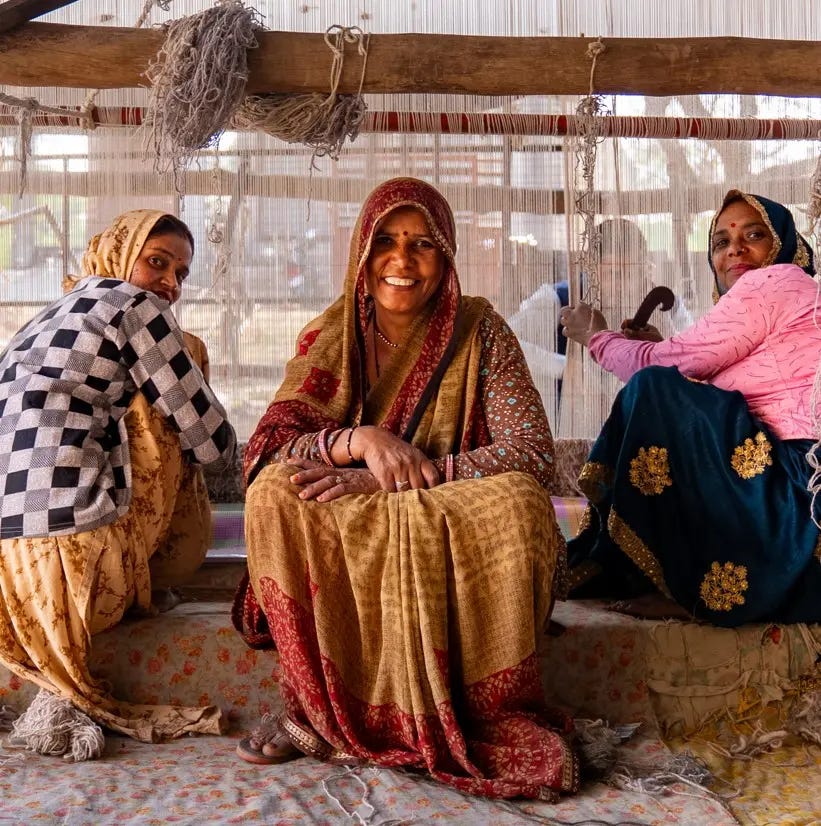
A few months back, we visited the artisan community in Aaspura, a village in Rajasthan, some odd 75 kms from the capital city of Jaipur. The artisans there weave rugs for Jaipur Rugs. To support their weavers, the company recognised its most experienced among them as Bunkar Sakhis (a weaver’s friend), women who guide other artisans from within the same village. We met one such Bunkar Sakhi in Aaspura, Prem Devi.
We asked her what it means to be a Bunkar Sakhi. She said, “Ek bunkar sakhi ko sabki sunni chaiye, ghabrana nahi chaiye aur narmayi se aana chaiye.” A Bunkar Sakhi should listen to everyone, not be afraid, and approach with gentleness.
This is what a Sakhi does. In Bihar, women in JEEVIKA’s self-help group network run small lending libraries, called Didi ki Library, in their villages. The library is led by a Didi (elder sister) who guides girls through exam options and career paths, because she understands the distance between a girl’s ambitions and what her family expects of her. In Uttarakhand, a Paryavaran Sakhi goes door to door collecting waste from households she has always been part of, every Tuesday morning.
Different work, different context, but the same thing is at the root of each: a woman who belongs to the community she serves.
There’s a kind of support that only works when it doesn’t have to introduce itself. When the person offering it grew up nearby. When she already knows the shortcut through the back lane, and whose grandmother isn’t doing well, and which door you have to knock on twice before anyone answers.
This is what sisterhood, at its best, has always offered— a space to grieve and grow in the same breath, without having to perform either. What these roles do is take something women have long offered each other and make it the foundation. This knowing, the kind that comes from living here, belonging here, is not incidental to the work. It is the work.
At FUEL, we keep asking ourselves: what counts as wisdom? Who counts as wise?
And then we meet the Sakhis, the women who already know before they’re told. And we think: this is what it looks like, embodied.
A question for this week:
Who in your life holds this kind of knowing, not because of a title, but because they’ve been present long enough to understand? Have you told them what that has meant?
In the warmth of the sisterhood,
Team FUEL.